
Can a Court Make AI Forget a Stolen Trade Secret?
Nov 11th, 2026 by Michael Dilworth | Recent News & Articles |
*This article was originally published in Cyber Defense Magazine. It can be downloaded here*
A pharmaceutical company spends years developing a faster, less expensive manufacturing process. It protects the process as a trade secret.
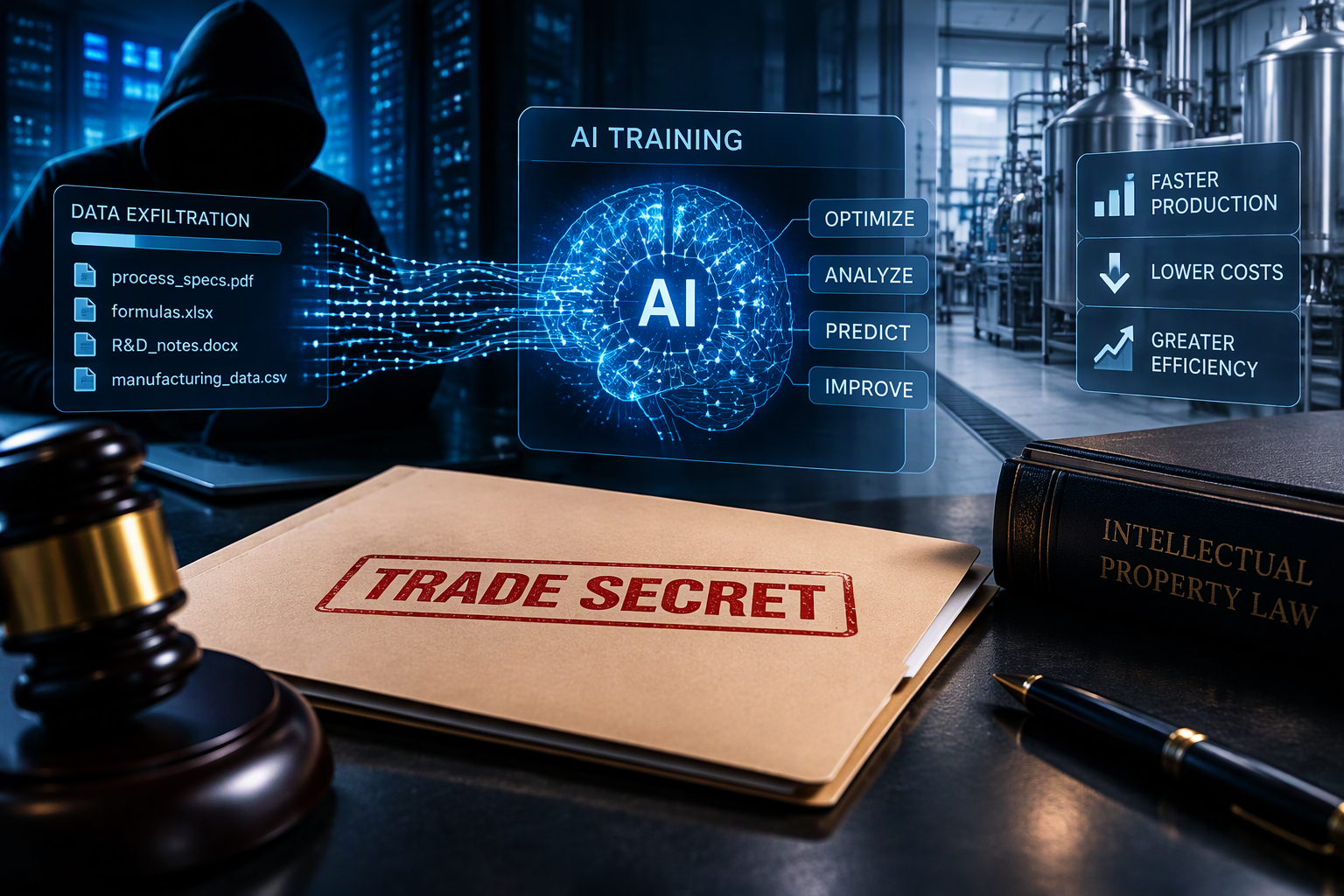
Hackers breach the company’s systems and steal the details. A competitor obtains the data and uses it to fine-tune an AI model that helps optimize its own production.
The company sues. It asks the court to stop the competitor from using the stolen information and to destroy every copy.
The files can be deleted. But the AI has already been trained.
Can a judge make the model forget what it learned? And how would anyone know whether it had?
A trade secret may survive deletion.
In a conventional trade secret case, the remedy often focuses on identifiable information: documents, source code, formulas, drawings, process specifications, or other materials that can be returned, deleted, or placed beyond further use.
AI complicates that model.
Training does not ordinarily leave the model holding a recognizable copy of each source document. Instead, the training process changes the model’s internal parameters based on patterns found in the data. In the pharmaceutical example, the model might learn relationships among temperature, timing, chemical concentrations, pressure, and production yield.
Deleting the stolen files would not necessarily remove those relationships from the model. The competitor could continue benefiting from them without ever reopening the original documents.
Machine unlearning is intended to address this problem by removing the influence of selected training data. But it does not yet provide a straightforward answer for courts. A model might stop reproducing a stolen formula when directly prompted while continuing to use relationships learned from that formula to improve a manufacturing process.
The legal question may therefore be easier to state than the technical one. A court can prohibit the use of a trade secret. It may be far more difficult to determine whether the influence of that secret has actually been removed from a trained model.
What could a court order?
Trade secret law gives courts broad authority to prevent actual or threatened misappropriation. Depending on the facts, a judge might order the competitor to:
- stop using the affected model;
- attempt to remove the influence of the stolen data;
- retrain the model using demonstrably clean data;
- restrict particular applications of the model; or
- destroy the model entirely.
None of these remedies is simple.
Retraining can be expensive and may not resolve disputes about which data or capabilities were affected. Destroying a model may eliminate unrelated functionality developed from legitimate sources. A narrowly tailored restriction may be difficult to enforce if the stolen information influenced capabilities throughout the model.
An order to “remove all traces” of the trade secret sounds decisive, but it may not establish an auditable standard for compliance. What testing would be required? Who would conduct it? How much access would an independent expert need? What level of residual influence would constitute a violation?
There is at least a regulatory analogue for reaching beyond the source data to the resulting model. In the Federal Trade Commission’s 2021 Everalbum matter, the company was required to delete not only certain photos and videos but also models and algorithms developed using them. That was a consumer-protection case, not a trade secret dispute, so the legal basis was different. Still, the remedy reflects an important principle: when improperly obtained information has been incorporated into an AI system, deleting the underlying data may not be enough.
The proof problem begins before the remedy.
In a typical insider case, there may be evidence that an employee downloaded confidential files, sent them to a personal account, or carried them to a new employer.
A cyber incident can be much more difficult to reconstruct.
The trade secret owner may first have to prove that the competitor received the stolen information. It may then need to show that the information entered an AI training pipeline and materially influenced the resulting model.
That proof could require forensic investigation, discovery of training records, access logs, model versions, internal communications, or other technical evidence. Some of the most probative material may itself contain the competitor’s trade secrets. Courts would have to balance the plaintiff’s need for evidence against the defendant’s legitimate interest in protecting its own confidential systems and data.
Even with substantial access, an expert may be unable to conclude with confidence that the model has completely forgotten the information. The inquiry becomes still more complicated if the model has already generated research, recommended process changes, or been used to train or improve other systems.
The original trade secret may no longer exist in one place. Its influence may have moved through a chain of models, decisions, and derivative work.
The competitive advantage may outlast the model.
Suppose the competitor uses the stolen process information to eliminate several years of research and enter the market earlier than it otherwise could have. Later, a court orders the model destroyed.
The order may stop further use of that particular system. It does not necessarily restore the competitive position that existed before the theft.
By then, the competitor may have improved its facilities, redesigned its manufacturing process, secured customers, lowered costs, or established a durable market position. Employees may also have learned from the model’s recommendations. Destroying the model does not make those people forget, reverse completed engineering work, or automatically undo the resulting commercial advantage.
Damages present a related problem. How much development time did the stolen information save? Which improvements resulted from the misappropriation, and which came from legitimate research? Would the competitor have reached the same result independently, and if so, when?
AI models can combine information from many sources. That makes causation harder to isolate and gives both sides room to dispute how much value should be attributed to the stolen material.
The benefit may also extend beyond the company that trained the model. Customers, contractors, and other third parties may use its outputs without ever seeing the source documents or knowing that a trade secret influenced the system.
Once embedded in an AI pipeline, the advantage can spread much further than the stolen files themselves.
Cybersecurity containment may not contain the competitive harm.
Traditional incident response remains essential. Compromised credentials must be reset. Access points must be closed. Systems must be contained, evidence preserved, and exposed data identified.
But those measures do not necessarily unwind what has already happened outside the owner’s environment.
If valuable process knowledge reaches a competitor’s AI pipeline, deleting the exfiltrated files may address possession without eliminating influence. A competitive advantage may persist long after the original data is gone.
That distinction matters for security teams, legal departments, and business leaders. The consequence of a breach may not be limited to disclosure of confidential information. It may include accelerated research, improved operations, lower production costs, or an earlier market entry that cannot be fully reversed.
What can trade secret owners do now?
No preventive measure will make these cases easy. Several steps, however, can put a trade secret owner in a stronger position to prove misappropriation and pursue a meaningful remedy.
Define and document the secret.
A company should be able to explain what the trade secret is with reasonable specificity. General assertions that “our process” or “our data” is confidential may be insufficient when the dispute turns on what entered a model and what the model learned from it.
The company should also maintain evidence of the measures used to protect the information, including access controls, encryption, monitoring, need-to-know restrictions, and confidentiality obligations imposed on employees, contractors, vendors, and business partners. These records can be important in establishing that the company took reasonable measures to preserve secrecy.
Treat AI use as a separate data-governance issue.
Restrictions on disclosure are no longer enough. Companies should consider whether high-value technical and process information may be used for AI training, fine-tuning, retrieval systems, evaluation, or other forms of model development.
Contracts with vendors and partners should address those uses expressly where appropriate. Internal policies should identify which information may enter AI systems, under what conditions, and with whose approval. Logging data flows can also make it easier to reconstruct events after a breach or unauthorized use.
Create evidence that can travel with the data.
Unique markers, digital watermarks, honeytokens, or canary files may help detect unauthorized access or support an inference that particular information reached another system.
These measures are not foolproof. A marker may disappear when data is transformed, summarized, or used only to influence model parameters. It may also be difficult to design a marker that remains useful without affecting the integrity of technical information.
Used carefully, however, these techniques can strengthen forensic evidence, guide discovery, and help connect an external system to specific stolen material.
Preserve evidence immediately.
The earliest stages of an incident may determine what can later be proved.
Counsel should be involved promptly so that appropriate legal holds and preservation measures can be implemented. Relevant logs, access histories, system images, model records, communications, and other evidence may be lost through routine operations if they are not preserved quickly.
Early investigation can also help identify exactly what left the environment and which facts would support targeted discovery into the suspected recipient’s systems.
The law may stop use without reversing the advantage.
A trade secret lawsuit may establish that information was stolen. A court may prohibit further use, award damages, require retraining, or order the destruction of an affected model.
Even then, the defendant may remain ahead because of what the model enabled it to learn or accomplish before the order was entered.
That is the central challenge. The law can prohibit continued use of a trade secret, but it may not be technologically possible to restore the world that existed before the secret shaped an AI system.
As AI becomes more deeply integrated into research, manufacturing, and product development, courts will have to decide what effective relief means when stolen knowledge is no longer confined to a document or database. Trade secret owners that clearly define their secrets, control their data flows, document their protections, deploy appropriate detection measures, and preserve evidence early will be in the strongest position to obtain remedies that matter.
To read this article from Cyber Defense Magazine click here*
This article, including any examples provided, is for informational and educational purposes only and does not constitute legal advice or a recommendation for any specific action. Readers should consult a qualified attorney regarding their particular circumstances. This article may be considered advertising under applicable state laws. Any opinions expressed are those of the author and do not necessarily reflect the views of Dilworth IP, its other attorneys, agents, staff, or clients.