
Claude’s New Watermark Could Create a New Risk for AI-Drafted Patents
Aug 18th, 2026 by Michael Dilworth | Recent News & Articles |
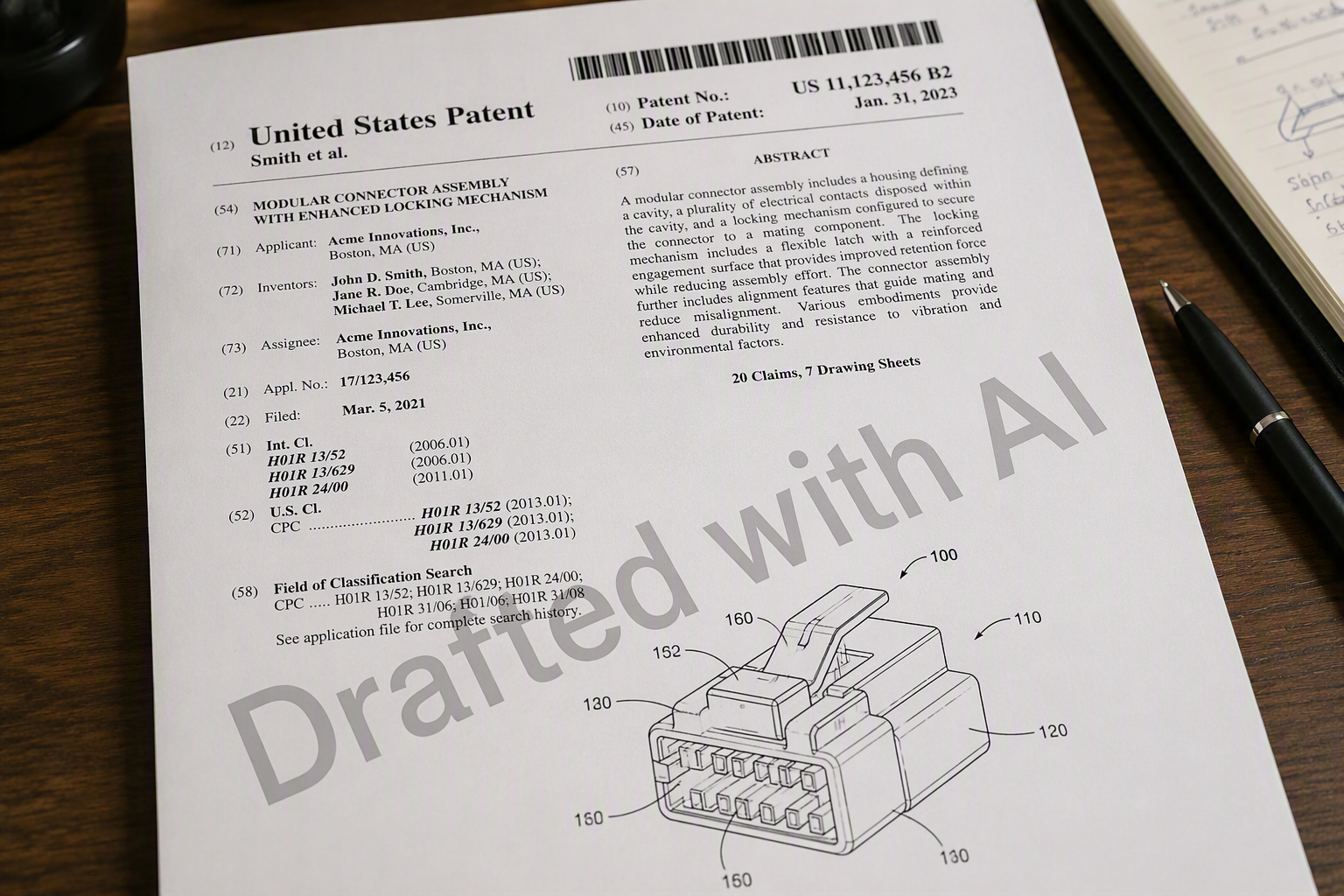
I have been thinking about Anthropic’s new approach to watermarking Claude-generated text, and I believe it could have an important consequence for companies using AI to help build their patent portfolios.
The watermark itself does not make a patent invalid.
The more interesting issue is what happens when a competitor can detect that AI helped write it.
Anthropic is introducing an invisible statistical watermark into text produced by future Claude models. The technology subtly influences word choices during generation. Readers cannot see it, and copying and pasting the text does not necessarily remove it. Some editing may leave enough of the signal intact to permit detection.
For companies using AI to prepare patent applications, that creates a new consideration.
The watermark may give a future accused infringer a roadmap for investigating exactly how the patent was created.
And what they find could matter.
Imagine This Patent Is Worth $100 Million
Consider a high-growth technology company building a patent portfolio around its core product.
Its engineers provide an invention disclosure. Claude helps turn that disclosure into a much more detailed patent application. Along the way, the AI proposes additional embodiments, variations, technical implementations, and perhaps solutions the original inventors had not considered.
The application is filed.
Five years later, the company is enforcing the resulting patent against a major competitor. The patent covers an important product category and potentially supports a significant damages claim or injunction.
The competitor detects Claude’s watermark in the patent.
I would expect its lawyers to start asking questions.
What did the inventors originally provide? What did Claude add? What prompts were used? Which embodiments came from the engineers and which came from the AI? Were the AI-generated technical details verified? Did any of those details eventually find their way into the patent claims?
Those questions could lead to demands for prompts, outputs, drafts, revision histories, internal communications, and testimony from the inventors.
For the patent owner, something that looked like an efficient drafting process years earlier may suddenly become part of the litigation.
Inventorship Could Become a Major Issue
This is where I see one of the most significant risks.
Under U.S. patent law, only human beings can be inventors. AI can be used as a tool, but the people named as inventors must have conceived the subject matter being claimed.
There is an important difference between using AI to describe an invention and using AI to develop the invention.
Suppose an engineer has already conceived a new product. Claude helps organize the disclosure, improve the writing, and describe concepts the engineer already understands.
That should generally present a very different inventorship situation from one in which Claude begins supplying new technical ideas.
Imagine instead that Claude is asked to propose alternative implementations. It generates ten possibilities. One is particularly interesting and gets added to the patent application.
Several years later, that embodiment turns out to be commercially important. The patent claims are amended during prosecution to cover it.
Now ask a simple question:
Who invented what is being claimed?
If the answer points back to the AI output, the patent owner could have a serious inventorship problem.
The USPTO currently treats AI as a tool and continues to apply traditional human inventorship principles. AI cannot simply be added as another inventor to solve the problem.
For founders and executives, this means AI-assisted patent drafting needs controls around what the AI is contributing. A longer specification filled with additional embodiments may look like a stronger patent application. It may create problems if nobody can establish human conception of the subject matter that ultimately matters.
The Patent Also Has to Work
There is another risk that may be even easier to understand.
Generative AI is extremely good at producing technically plausible language.
Plausible and correct are different things.
If an AI system fills gaps in an invention disclosure with technical details that are inaccurate, incomplete, or unworkable, those statements can become embedded in the patent application.
That matters because a patent is supposed to demonstrate that the inventors actually “possessed” the invention and teach others how to make and use it.
A beautifully written 50-page patent application is not necessarily a strong patent.
If important portions were generated by AI and never meaningfully verified by the inventors, a competitor may have another avenue for attacking it.
This is where the watermark again becomes relevant. It can help identify the portions of the document worth investigating and potentially connect those passages back to the underlying AI interactions.
Confidentiality Matters Too
Companies should also pay attention to where their invention information is going.
There is a meaningful difference between using an enterprise AI environment with appropriate confidentiality, retention, data-isolation, and non-training protections and dropping an entire invention disclosure into a consumer-facing AI system.
I would not assume that submitting confidential information to an AI platform automatically makes an invention public for patent-law purposes. The answer depends on how the particular system handles the information.
Before providing valuable, potentially patentable technology to an AI system, know what happens to the data. This is especially important for companies seeking patent protection internationally, where premature disclosure can have severe consequences.
AI Can Still Make Patent Drafting Better
None of this means companies should avoid AI in the patent process.
I think the opposite will happen.
AI will become deeply embedded in patent preparation because it can help analyze invention disclosures, identify missing information, generate questions for inventors, organize complex technical material, and accelerate drafting.
The issue is how it is used.
Companies should treat AI as a powerful tool operating inside a controlled patent-development process.
Inventors should review substantive additions. Patent counsel should determine whether new embodiments came from the inventors or the AI. Technical statements should be verified. Sensitive information should be handled in appropriate AI environments.
Companies should also preserve good contemporaneous records of conception. Engineering documents, invention disclosures, drawings, inventor comments, development records, and appropriate revision histories could become extremely valuable if a competitor later challenges where important subject matter originated.
The objective should not be eliminating the watermark.
The objective should be building patents that remain strong even when everyone knows AI was involved.
The Bigger Business Issue
For founders, investors, and executives, patents are ultimately business assets.
A patent may someday support a financing, increase acquisition value, protect a major product line, block a competitor, support licensing revenue, or become the basis for litigation involving hundreds of millions of dollars.
The quality of the process used to create that patent therefore matters.
Claude’s watermark does not change the legal requirements for obtaining a valid patent. What it changes is visibility into how the document may have been created.
That could make it much easier for a future competitor to ask where an important embodiment originated, whether the inventors actually conceived it, and whether the technical disclosure was ever meaningfully verified.
Those are questions every innovative company using AI in its patent process should be prepared to answer.
Because five or ten years from now, someone may have a very large financial incentive to ask them.
Any examples are solely for educational and illustrative purposes. They do not constitute legal advice and should not be construed as recommendations for specific actions. For personalized legal guidance, please consult a qualified attorney.
This article is for informational purposes, is not intended to constitute legal advice, and may be considered advertising under applicable state laws. The opinions expressed in this article are those of the author only and are not necessarily shared by Dilworth IP, its other attorneys, agents, or staff, or its clients.