
Beyond Attorney Argument: Using SMEDs to Overcome Section 101 Rejections
Oct 22nd, 2026 by John Kokolakis | Intellectual Property | Recent News & Articles |
Section 101 rejections remain one of the more challenging issues we encounter in patent prosecution, particularly for software and computer-implemented inventions. In many cases, the difficulty is not simply what the law requires, but how the examiner understands the technology and the factual premises underlying the rejection.
We recently encountered exactly that situation in prosecuting a computer-implemented invention. Rather than relying solely on claim amendments and attorney argument, we used a Subject Matter Eligibility Declaration, or SMED, together with an examiner interview to build a stronger record addressing the Section 101 rejection.
That ability to strengthen the prosecution record is one of the most useful aspects of a SMED. Although entirely optional, a SMED allows an applicant to introduce factual evidence supporting patent eligibility and can help clarify technical issues that may not be apparent from the claims and attorney argument alone. The USPTO itself has recognized that SMEDs can clarify the record and lead to stronger patents.
Recent USPTO guidance provides additional direction on how practitioners can use this tool effectively.
What Is a SMED?
A Subject Matter Eligibility Declaration, or SMED, is a declaration submitted under 37 C.F.R. § 1.132 that allows an applicant to introduce factual evidence supporting patent eligibility under Section 101. SMEDs are optional, but they can be particularly useful when an eligibility dispute turns on factual questions about the claimed technology.
The distinction between evidence and attorney argument is important. An attorney might argue that a claimed process cannot practically be performed in the human mind or that the claimed invention improves the functioning of a computer or another technology. A SMED can provide factual support for those positions, such as technical testimony, comparative testing, evidence concerning the state of the art, or evidence explaining how a person of ordinary skill would understand the disclosed technology.
Start With the Rejection
An effective SMED starts with understanding what is actually driving the Section 101 rejection. Before deciding who should provide the declaration or what evidence to include, practitioners should identify the particular factual premise underlying the examiner’s position.
For example, is the examiner treating claimed operations as something that can practically be performed in the human mind? Is the examiner overlooking an improvement to computer functionality or another technology? Or is the examiner treating particular claim elements as well understood, routine, and conventional? The evidence presented in the SMED should be directed to the issue that actually matters to the rejection.
The USPTO’s recent guidance reinforces this approach, recommending that applicants specifically identify the aspect of the eligibility analysis that the SMED is intended to support.
A useful approach is to work backward from the rejection: identify the relevant claim limitation, identify the eligibility issue associated with that limitation, determine the factual proposition that matters, and then develop evidence directed to that proposition.
That keeps the declaration focused on facts that can meaningfully strengthen the prosecution record rather than simply repeating the attorney’s legal argument.
Build an Effective Evidentiary Record
Once the factual issue is identified, the next question is what evidence will actually help establish it. The USPTO emphasizes that there should be a nexus between the evidence and the claimed invention, and that objective evidence should be supported by actual proof. Relevant evidence may include comparative testing, technical data, information about the state of the art, or evidence explaining how a person of ordinary skill would understand the disclosed technology.
The USPTO also permits the declaration to come from an inventor, coworker, independent expert, or another person with knowledge of the relevant facts. Its recent guidance notes that evidence from a disinterested person may, depending on the circumstances, be more persuasive.
Practically, the evidence and the declarant should fit the issue. An inventor may be best positioned to address testing or technical development, while an independent expert may be better suited to address the state of the art or how the technology would be understood by a person of ordinary skill.
There is one important limitation: a SMED cannot supply information that should have been included in the application when originally filed. It can help explain what the application already teaches, but it cannot rewrite the disclosure after filing.
The evidentiary record matters because eligibility is ultimately evaluated under a preponderance of the evidence standard. As the USPTO’s new flowchart emphasizes, a Section 101 rejection is proper only when it is more likely than not that the claims are ineligible, and a 50/50 split should be resolved in the applicant’s favor.
Practical Lessons From the USPTO’s New Guidance
The USPTO’s September 29, 2026 memorandum and accompanying flowchart provide additional practical guidance for preparing and submitting SMEDs. The flowchart is particularly useful because it lays out how an examiner will review a SMED for formal sufficiency and then evaluate the evidence on the merits. Perhaps most notably, the USPTO encourages applicants to think about SMEDs earlier in prosecution. A SMED may be submitted even before a first action on the merits, which may allow relevant evidence to be considered as part of the examiner’s initial eligibility analysis.
The flowchart also serves as a useful reminder that substance is only part of the analysis. Before considering a SMED on the merits, the examiner first determines whether the declaration is timely and satisfies the applicable declaration formalities.
The USPTO also recommends clearly identifying the particular eligibility issue the declaration is intended to address and considering submission of the SMED separately from declarations directed to other patentability issues. When filing a SMED separately through Patent Center, the USPTO recommends using the dedicated document code AF/D.SMED, making the declaration more readily identifiable during prosecution.
Another important takeaway is that a SMED does not have to operate in isolation. The USPTO specifically encourages examiner interviews where they may improve the parties’ understanding of eligibility issues, including those addressed by a SMED.
From our perspective, the broader lesson is to treat the SMED as part of the prosecution strategy, rather than simply another document to file with an Office Action response. The evidence, the written response, any claim amendments, and the examiner interview should work together to address the particular eligibility issue presented.
Hypothetical Case Study
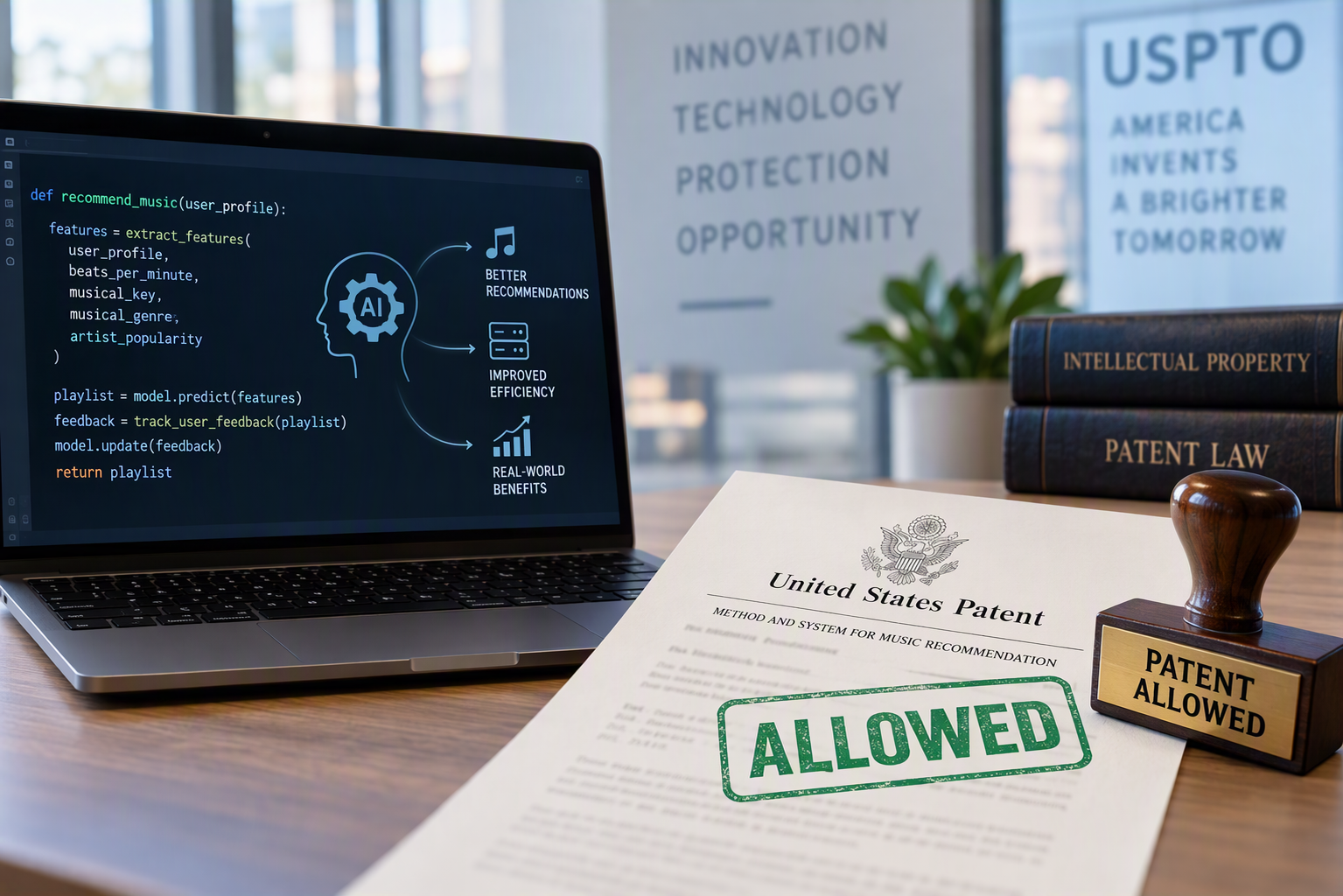
Consider an application directed to an AI-based music recommendation system for a streaming platform. The claims recite a machine learning model that analyzes a user’s music taste profile, extracts specific characteristics from it (beats per minute, musical key, musical genre, and artist popularity), and tracks those characteristics in real time as a feedback loop to refine the playlist suggested to the user.
The examiner rejected the claims under Section 101 as directed to an abstract idea, reasoning that selecting songs based on a listener’s preferences is something a person could perform in the human mind using pen and paper. The rejection did not address a section of the specification showing that the claimed approach improved the accuracy of the recommendation mechanism, as evidenced by lower skip rates through the entire song and increased repeat listens of suggested songs. The specification also included data showing that those lower skip rates and increased repeat listens reduced strain on the server and improved bandwidth and latency for all users of the platform.
That made it a good fit for a SMED. The question was not what the application disclosed, because the evidence was already there. The question was whether the examiner saw the connection between the claim language and the technical results described in the specification.
The declaration, submitted by the inventor, pointed the examiner to the overlooked data in the application. It then explained how the claimed AI algorithm’s extraction of beats per minute, musical key, musical genre, and artist popularity, and the real-time tracking of those characteristics as a feedback loop, directly correlated with the lower skip rates and increased repeat listens. Finally, it tied those results to the server-side improvements: fewer skipped and abandoned streams meant less wasted data transmission, which reduced server load and improved bandwidth and latency across the platform.
Because the declaration relied on data already in the application, it did not raise any concern about adding new information after filing. It explained what the application already taught and connected that teaching to the claims.
The SMED persuaded the examiner. With the record laid out in the declaration, the examiner agreed that the claims integrated the AI algorithm into a practical application: improving the functioning of music recommendation streaming services by improving resource efficiency. The examiner could not see the link between the claims and that practical application from the claims and attorney argument alone. The declaration made it clear.
SMEDs as Part of a Broader Section 101 Strategy
A SMED is not a substitute for a well-drafted specification, thoughtful claim amendments, or a persuasive Section 101 response. It is another tool available when an eligibility dispute turns on factual questions that may benefit from evidence.
Our recent experience reinforced that point. We used a SMED together with an examiner interview to address a challenging Section 101 rejection, combining the factual record developed through the declaration with a direct discussion of how that evidence related to the claimed technology.
The practical takeaway: when addressing a Section 101 rejection, ask what is driving the rejection and whether factual evidence can help overcome it.
This article, including any examples provided, is for informational and educational purposes only and does not constitute legal advice or a recommendation for any specific action. Readers should consult a qualified attorney regarding their particular circumstances. This article may be considered advertising under applicable state laws. Any opinions expressed are those of the author and do not necessarily reflect the views of Dilworth IP, its other attorneys, agents, staff, or clients.